AI Replacing Humans or Humans Controlling AI - How?
This question has existed since the first computer was invented, and with the explosion of Generative AI, it has become more urgent than ever. The answer is not to choose one or the other, but to understand the boundary.
1. What will AI replace?
AI does not replace humans; it replaces tasks. History shows this very clearly.
AI does better than humans in 3 groups of tasks:
- Repetitive, large-scale tasks: Data entry, classifying 10,000 defect images on a production line, synthesizing daily production reports.
- Pattern recognition in big data: Predicting when a motor will fail based on vibration data, detecting financial fraud.
- High-speed decision support: Suggesting optimal routes for AGVs, proposing optimal machining parameters.
These tasks previously took up 60-70% of an engineer's or a QC staff's time. When AI does them, people don't lose their jobs, but are freed to do higher-value work.
AI cannot replace:
- Responsibility and ethics: Who is responsible when a self-driving car causes an accident? AI cannot go to court.
- Contextual creativity: AI can draw 100 design samples, but humans decide which sample is suitable for the culture and emotions of Japanese or Vietnamese customers.
- Trust and connection: Customers want to negotiate with a human, employees want to be understood by a human manager.
2. How do humans control AI? - The 3-Layer Model
To prevent AI from going out of control, leading factories and corporations are applying a 3-layer control model:
Layer 1: Control in Design (Human-in-the-Loop)
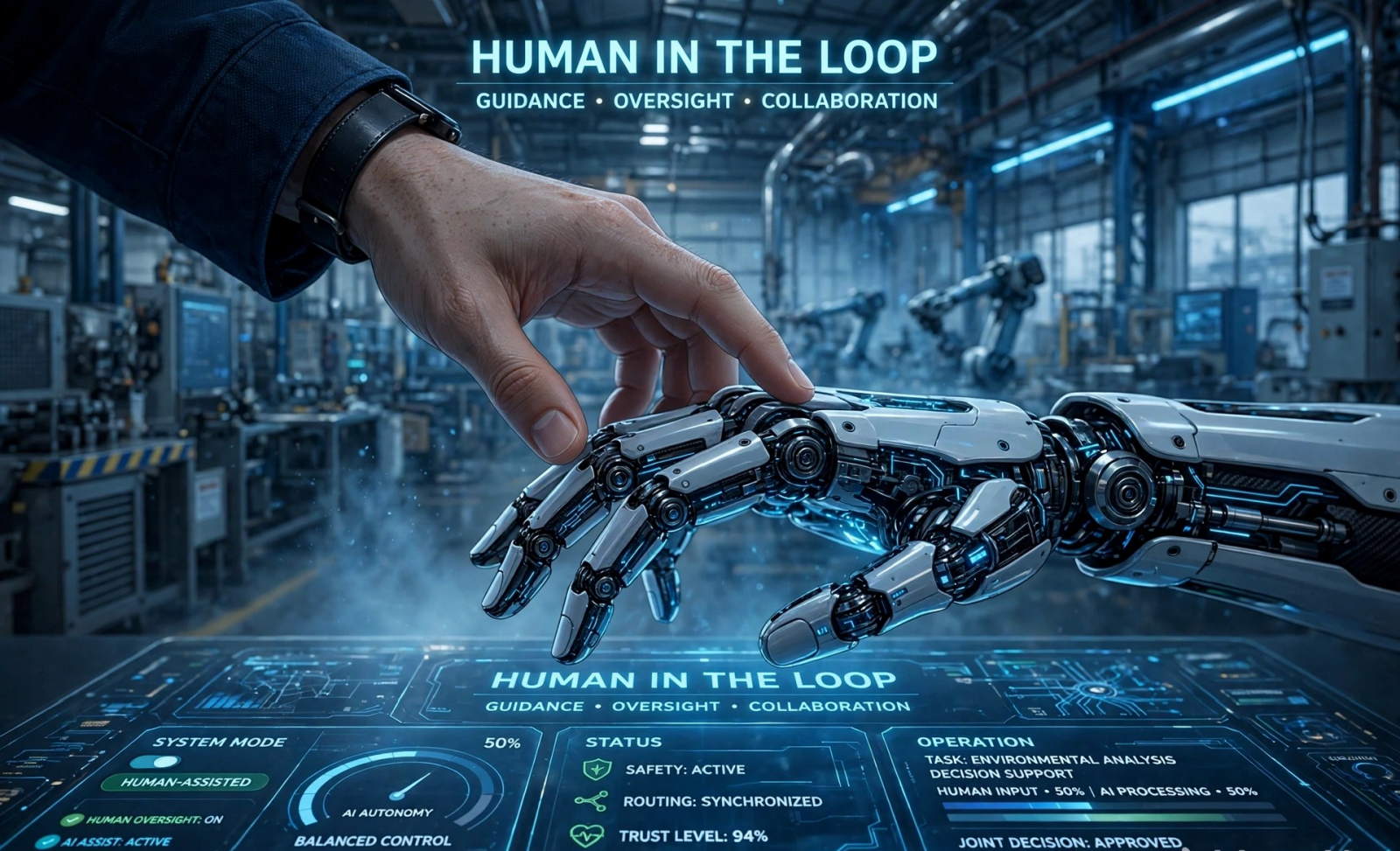
Humans are always in the loop. AI only provides suggestions, humans approve.
For example: The AI Vision system detects a defective product and proposes to remove it, but the final decision to stop the entire line must be confirmed by the team leader. This is the spirit of Jidoka from Japan.
Layer 2: Control by Data and Process (Governance)
- Clean and traceable data: AI is only as smart as the data it learns from. Factories must digitize data honestly, not falsify data for AI to learn incorrectly.
- Guardrails: Set hard limits. For example: The robot must not exceed 5Nm tightening force no matter how AI calculates, the furnace must not exceed 800 degrees.
- Traceability: Every AI decision must be logged: why it made that decision, based on what data.
Layer 3: Control by People and Culture (Oversight)
This is the most important layer.
- Upskilling, not replacing: Invest in reskilling workers from manual operations to operating and supervising AI. A worker who knows how to use AI will replace a worker who doesn't know how to use AI.
- AI Ethics Committee: Within the company, there need to be clear regulations on what AI is allowed to do and not allowed to do.
Conclusion:
The future is not "AI vs. Human", but "Human + AI vs. Human without AI".
As in the illustration, the human hand is on top, guiding the machine hand. AI is a tool that amplifies human capabilities, just like an excavator amplifies muscle power. A person who controls the excavator well will do more work, more safely.