The Superiority of Data Digitalization in Factories - The Foundation of Industry 4.0
In the context of the Fourth Industrial Revolution, data digitalization is no longer an option but a survival requirement for factories. In the past, production data was recorded manually and stored on scattered papers. Today, every parameter from machine temperature, vibration, speed, output, and defects is collected by sensors and uploaded to the system in real time.
1. Transparency and Real-Time Decision Making
Digitalization allows managers to see the entire factory on a single dashboard. OEE (Overall Equipment Effectiveness), output, defect rate, and energy consumption are updated every second. Instead of waiting for end-of-shift or end-of-day reports, leaders can intervene immediately when anomalies occur.
2. Predictive Maintenance - Reducing Costs and Avoiding Unexpected Downtime
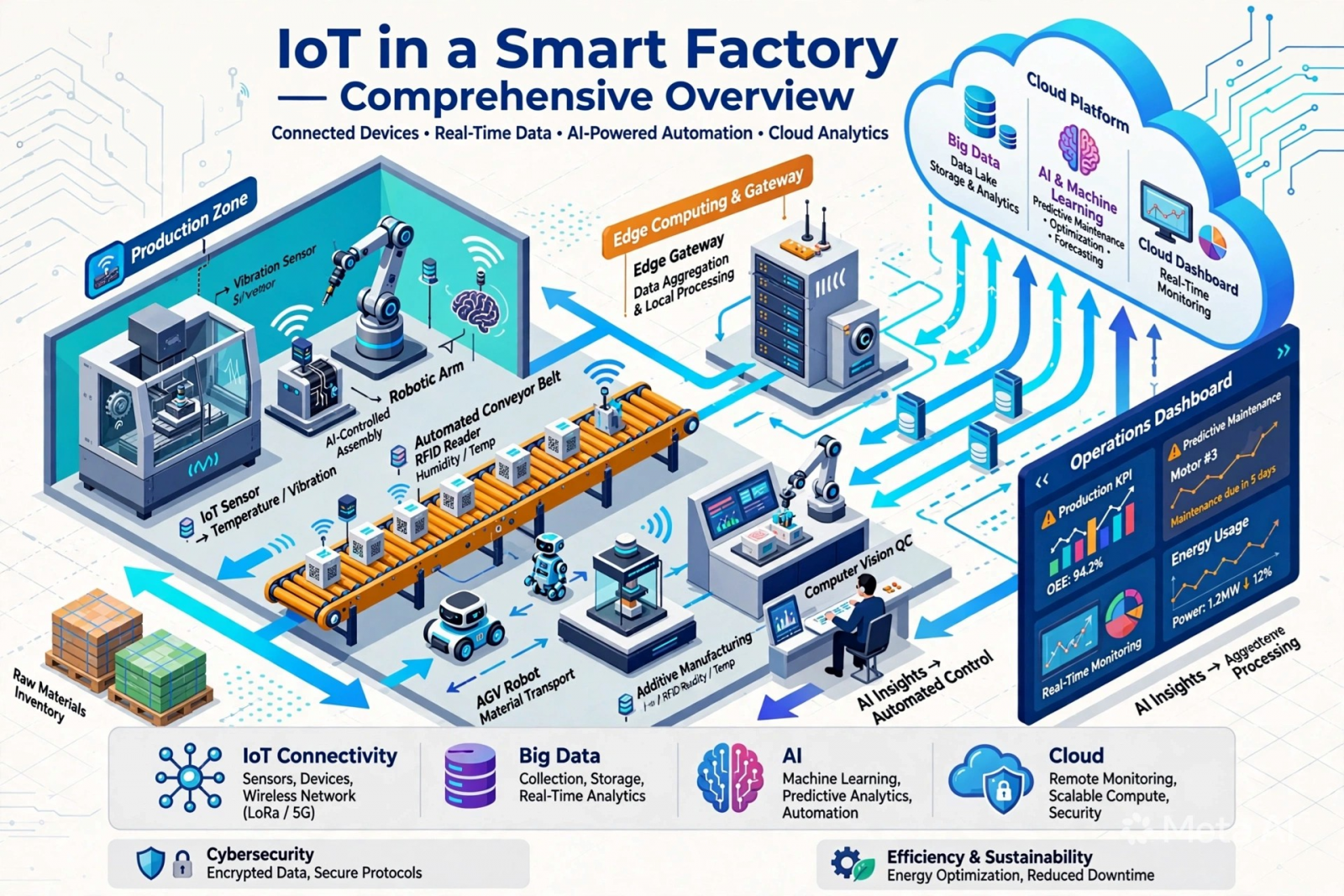
This is the biggest benefit. IoT sensors attached to motors and bearings continuously measure vibration and temperature. The AI system analyzes trends and warns 5-10 days in advance that "Motor #3 will fail". The factory proactively schedules maintenance, avoiding hundreds of millions in losses due to sudden line stoppages. As shown in the image, this is the loop from IoT Sensor -> Edge Computing -> AI & Machine Learning -> Alert.
3. Quality Improvement and Full Traceability
Each product passing through the conveyor is tagged with a QR/RFID code. Data on who produced it, on which machine, at what temperature, and the results of computer vision QC are all saved. When there is a complaint, just scanning the code retrieves the entire history, helping to pinpoint errors accurately and reduce scrap.
4. Operational Optimization and Energy Saving
Big Data allows analysis of correlations that humans cannot see. For example: which machine consumes the most electricity and at what time frame? Optimizing AGV Robots to transport materials on the shortest route. The result is a 10-15% reduction in energy costs and increased material efficiency.
5. Flexible Supply Chain Connection
When raw material inventory data is digitized and connected with production data and orders, the system automatically warns of stock-outs and automatically places orders. The factory becomes an intelligent link in the supply chain, responding quickly to market fluctuations.
In conclusion, data digitalization transforms a factory from a mere mechanical machine into a living organism capable of self-sensing, self-thinking, and self-optimizing. It is the step from automation to autonomy. Whoever masters data will master the future.